
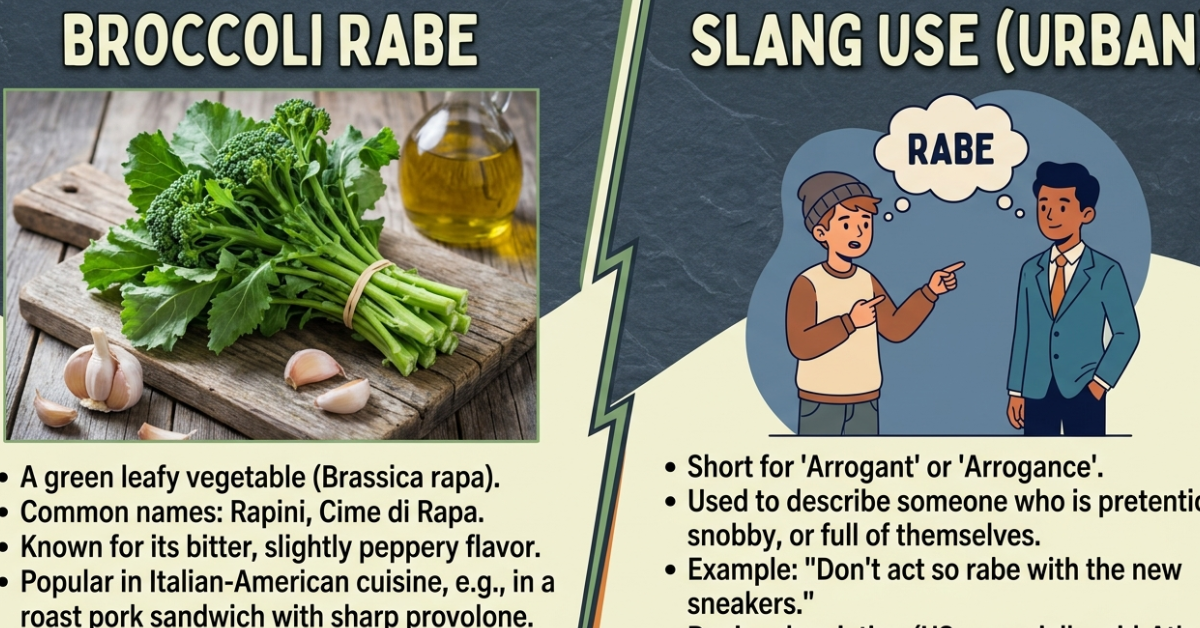

Have you ever come across the term rabe meaning and wondered what it actually refers to? You are not alone, because many people search for broccoli rabe meaning, rabe meaning in English, and rabe meaning slang when they see this unfamiliar word online or in recipes.
Interestingly, the confusion comes from the fact that “rabe” mainly belongs to food vocabulary. In most cases, it describes a leafy green vegetable used in Mediterranean and Italian cooking. Therefore, this article explains its meaning in a simple, clear, and practical way so you never feel confused again.
What Does Rabe Mean?
The rabe meaning mainly connects to culinary language rather than everyday speech. In most situations, it refers to a vegetable known as rapini, which people often use in cooking.
When you see the word in recipes or grocery stores, it usually describes a leafy green ingredient rather than slang or slang-based expressions. Because of that, understanding the context becomes very important.
To make it simple:
- “Rabe” usually refers to a vegetable
- It rarely appears in casual conversation
- It does not function as common slang
Broccoli Rabe Meaning Explained
Broccoli Rabe refers to a leafy green vegetable that looks similar to broccoli but tastes more bitter and earthy. Although the name includes “broccoli,” it does not belong to the same category as regular broccoli.
Key characteristics include:
- It grows with leafy stems and small buds
- It carries a naturally bitter flavor
- Chefs often use it in Italian-style dishes
- It contains important vitamins and nutrients
People usually sauté it with garlic, olive oil, or chili flakes. As a result, it has become a popular ingredient in healthy Mediterranean cooking.
Rabe Meaning in English Explained Simply
When you look at rabe meaning in English, you will notice that it does not have a strong dictionary-style definition on its own. Instead, English speakers use it mainly in food contexts.
In most cases, the word works as:
- A shortened form of rapini
- A culinary label used in recipes
- A grocery store term for leafy greens
Since English usage focuses on cooking, the word rarely appears in general conversation. Therefore, its meaning stays closely tied to food culture rather than language rules.
Does Rabe Have a Slang Meaning?
Many people search for rabe meaning slang, expecting a hidden or informal definition. However, no widely accepted slang meaning exists for this word in English.
Instead, the confusion happens because:
- The word sounds unfamiliar
- It appears in different spelling variations
- It gets mixed with unrelated slang searches online
Even though internet users sometimes assume a hidden meaning, linguists and dictionaries do not recognize “rabe” as slang. Therefore, you can safely treat it as a food-related term only.
Why People Get Confused About Rabe Meaning
Several reasons explain why rabe meaning confuses so many people.
First, similar-sounding words often mislead readers. For example, “rabe” can sound like other English words, which creates misunderstandings during searches.
Next, different regional names increase confusion. The same vegetable appears under multiple names, such as:
- Broccoli rabe
- Rapini
- Rabe greens
Finally, limited familiarity with the vegetable makes the term feel unusual. As a result, people search online to confirm what it actually means.
How Rabe Is Used in Real Life
You will mostly encounter “rabe” in food-related situations rather than conversation.
In grocery stores:
Shoppers usually find it labeled as broccoli rabe or rapini in the fresh produce section.
In cooking:
Chefs often sauté it, steam it, or mix it with pasta dishes. Garlic and olive oil commonly enhance its flavor.
In everyday language:
People rarely use it outside cooking discussions, so it does not function as slang or casual vocabulary.
Nutritional Benefits of Broccoli Rabe
Beyond its meaning, this vegetable also offers strong nutritional value.
Broccoli Rabe provides several health benefits that make it popular in healthy diets.
Key benefits include:
- Improves digestion due to high fiber content
- Strengthens immunity with vitamin C
- Supports bone health with vitamin K
- Provides antioxidants for overall wellness
Because of these benefits, many people include it in balanced meal plans, especially Mediterranean-style diets.
Common Misconceptions About Rabe Meaning
Many misunderstandings surround the rabe meaning, so let’s clear them up.
One common myth claims that rabe equals broccoli. However, this is incorrect because it belongs to a different plant category.
Another misconception suggests it works as slang. In reality, no linguistic evidence supports that claim.
Some people also think it has multiple meanings. Even though it appears in different contexts, its primary use stays focused on food.
FAQs About Rabe Meaning
1. What does rabe meaning refer to?
It mainly refers to a leafy green vegetable used in cooking, especially in Italian cuisine.
2. Is broccoli rabe the same as broccoli?
No, it differs in taste, texture, and botanical classification.
3. Does rabe have slang meaning?
No, it does not have any widely accepted slang meaning in English.
4. Where do people commonly use the word rabe?
People usually see it in recipes, grocery stores, and cooking discussions.
5. Why is it called broccoli rabe?
It gets its name because it resembles broccoli buds, even though it is not true broccoli.
Conclusion
In conclusion, the rabe meaning becomes clear once you understand its primary use. It mainly refers to a leafy green vegetable used in cooking rather than slang or informal language.
Moreover, when people search for broccoli rabe meaning, they usually want to identify this unique vegetable and understand how it fits into recipes. Therefore, recognizing its culinary origin helps remove all confusion.
Finally, once you learn this term, you will notice it appears mostly in food contexts, making it a simple but interesting part of culinary vocabulary.