
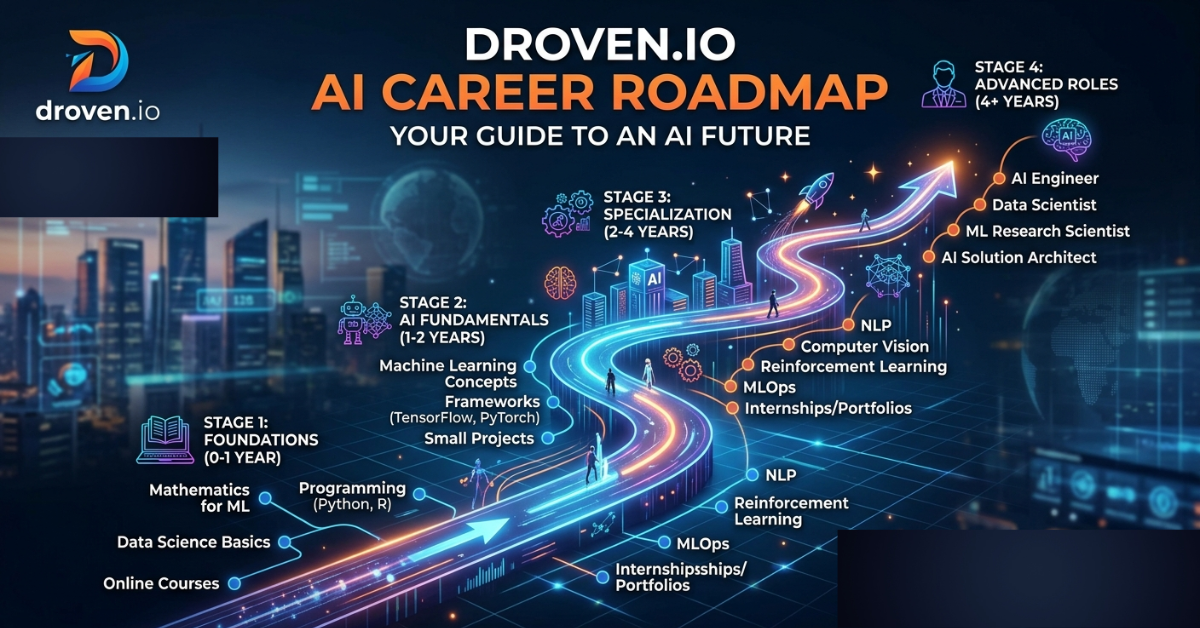

Artificial intelligence is no longer a futuristic concept hidden inside research labs. It’s now shaping industries, transforming businesses, and creating entirely new career opportunities across the world. Whether you’re a student, developer, marketer, or someone planning a career switch, understanding the droven.io ai career roadmap can help you navigate the rapidly evolving AI landscape with confidence.
The biggest challenge for most people isn’t the lack of opportunity — it’s knowing where to begin. AI careers can feel overwhelming because there are so many tools, specializations, and learning paths available today. That’s where a structured roadmap becomes valuable. Instead of randomly learning technologies, you follow a clear path designed around practical growth and real-world skills.
In this guide, we’ll break down what the roadmap offers, the skills needed for modern AI careers, and how aspiring professionals can position themselves for long-term success in the tech industry.
What Is the Droven.io AI Career Roadmap?
The droven.io ai career roadmap is a structured learning framework designed to help individuals understand the progression of AI-related careers. It focuses on guiding learners from foundational concepts to advanced specializations through organized milestones.
Unlike scattered online tutorials, a roadmap provides direction. It helps learners identify:
- Which skills to learn first
- What technologies matter most
- How AI roles differ from one another
- Which tools are commonly used in the industry
- How to build practical experience
The roadmap is especially useful because AI is a broad field. Someone interested in machine learning engineering may need a different path compared to a person pursuing AI product management or data science.
Why AI Career Roadmaps Matter Today
The AI industry is growing at an incredible speed. Companies across healthcare, finance, cybersecurity, education, e-commerce, and automation are investing heavily in artificial intelligence solutions.
This rapid growth has created a skills gap. Employers are actively searching for professionals who understand:
- Machine learning
- Data analysis
- Neural networks
- Automation systems
- Prompt engineering
- AI ethics
- Generative AI technologies
Without a roadmap, learners often waste time jumping between unrelated courses and tools. A structured career guide helps reduce confusion while building job-ready expertise.
Key Skills Included in an AI Learning Path
A successful AI career requires both technical and practical skills. The roadmap typically begins with foundational concepts before moving into specialized areas.
1. Programming Fundamentals
Most AI professionals start with programming languages like:
- Python
- R
- JavaScript
- SQL
Python remains the most widely used language in machine learning and data science because of its extensive AI libraries and beginner-friendly syntax.
2. Mathematics and Statistics
AI systems rely heavily on mathematical principles. Core concepts include:
- Linear algebra
- Probability
- Statistics
- Calculus
- Optimization techniques
While you don’t need to become a mathematician, understanding these fundamentals helps when building and training models.
3. Data Handling and Analysis
AI models are only as good as the data they use. Learners must understand:
- Data cleaning
- Visualization
- Data preprocessing
- Feature engineering
- Dataset management
Strong data skills improve model accuracy and decision-making.
4. Machine Learning Basics
This stage introduces learners to supervised and unsupervised learning methods.
Popular topics include:
- Regression models
- Decision trees
- Clustering
- Classification
- Model evaluation
This is often where beginners start creating their first AI projects.
5. Deep Learning and Neural Networks
Advanced learners move into deep learning concepts using frameworks like:
- TensorFlow
- PyTorch
- Keras
These tools are commonly used in image recognition, language processing, and generative AI applications.
Popular Career Paths in Artificial Intelligence
One reason the AI field attracts so many learners is the variety of available career opportunities. The roadmap often branches into multiple specializations depending on individual interests.
AI Engineer
AI engineers develop intelligent systems and integrate machine learning models into applications. They often work with automation tools, cloud platforms, and production pipelines.
Data Scientist
Data scientists analyze large datasets to uncover insights and predict outcomes. This role combines coding, statistics, and business understanding.
Machine Learning Engineer
This role focuses heavily on building, training, and deploying machine learning models for real-world applications.
AI Researcher
Researchers work on developing new algorithms, improving model performance, and advancing artificial intelligence technologies.
Prompt Engineer
As generative AI tools continue growing, prompt engineering has emerged as a valuable skill. Professionals optimize prompts for systems like chatbots, image generators, and language models.
How Beginners Can Start an AI Career
Getting started in AI doesn’t require a computer science degree. Many professionals successfully enter the field through self-learning and practical experience.
Here’s a beginner-friendly approach:
Step 1: Learn Basic Programming
Start with Python and understand variables, loops, functions, and object-oriented programming.
Step 2: Study Data Fundamentals
Practice handling datasets and using tools like Pandas and NumPy.
Step 3: Explore Machine Learning
Begin with beginner-friendly algorithms and small projects.
Step 4: Build Real Projects
Hands-on projects help reinforce learning while creating a portfolio for employers.
Examples include:
- Chatbots
- Recommendation systems
- Sentiment analysis tools
- AI-powered dashboards
Step 5: Choose a Specialization
After learning the basics, focus on an area that aligns with your goals.
The Importance of Portfolio Projects
Certifications alone are no longer enough in the AI industry. Employers increasingly want proof of practical ability.
A strong portfolio demonstrates:
- Problem-solving skills
- Technical expertise
- Creativity
- Real-world application experience
Some project ideas include:
- AI resume screening tools
- Image classification systems
- Predictive analytics dashboards
- Voice recognition applications
- Generative AI content assistants
Even small projects can significantly improve job prospects when presented properly.
Common Challenges AI Learners Face
Learning artificial intelligence can feel difficult at first. Many beginners experience frustration when trying to understand complex concepts quickly.
Common obstacles include:
Information Overload
There are thousands of tutorials, tools, and frameworks online. A roadmap helps learners stay focused.
Lack of Practical Experience
Many learners spend too much time watching courses instead of building projects.
Fear of Mathematics
AI includes mathematical concepts, but beginners can learn gradually without mastering everything immediately.
Rapid Industry Changes
AI tools evolve constantly. Staying updated through communities, newsletters, and projects is essential.
Future Trends in AI Careers
Artificial intelligence continues evolving beyond traditional machine learning roles. The future will likely create even more specialized career paths.
Emerging areas include:
- Generative AI development
- AI cybersecurity
- Autonomous systems
- AI ethics and governance
- Human-AI collaboration
- AI-powered healthcare solutions
Professionals who continuously adapt and improve their skills will remain highly valuable in the market.
Best Practices for Long-Term Success in AI
To succeed in the AI industry, consistency matters more than speed.
Here are some proven strategies:
- Build projects regularly
- Practice problem-solving daily
- Join AI communities
- Contribute to open-source projects
- Stay updated with industry trends
- Learn cloud and deployment tools
- Improve communication skills
Technical knowledge is important, but collaboration and adaptability are equally valuable in modern tech environments.
FAQs
What is the droven.io ai career roadmap?
It is a structured guide that helps learners understand how to build skills and progress toward careers in artificial intelligence and machine learning.
Is AI a good career choice in 2026?
Yes. AI continues to grow rapidly across industries, creating strong demand for skilled professionals worldwide.
Do I need a degree to work in AI?
Not necessarily. Many successful AI professionals are self-taught and build careers through projects, certifications, and practical experience.
Which programming language is best for AI?
Python is currently the most popular language for AI and machine learning because of its simplicity and extensive libraries.
How long does it take to learn AI?
The timeline varies depending on experience and learning consistency. Beginners may need several months to build foundational skills and practical projects.
What are the highest-paying AI jobs?
Roles such as machine learning engineer, AI architect, AI researcher, and data scientist are among the highest-paying positions in the field.
Conclusion
The world of artificial intelligence offers enormous opportunities, but success depends on following a clear and practical learning path. The droven.io ai career roadmap helps simplify the process by providing structure, direction, and skill progression for aspiring professionals.
Instead of trying to learn everything at once, focus on building strong foundations, practicing through projects, and choosing a specialization that matches your interests. AI is evolving quickly, and those who stay curious and adaptable will continue to thrive in this exciting industry.
Whether you’re just starting out or planning your next career move, now is one of the best times to invest in AI skills and prepare for the future of technology.