
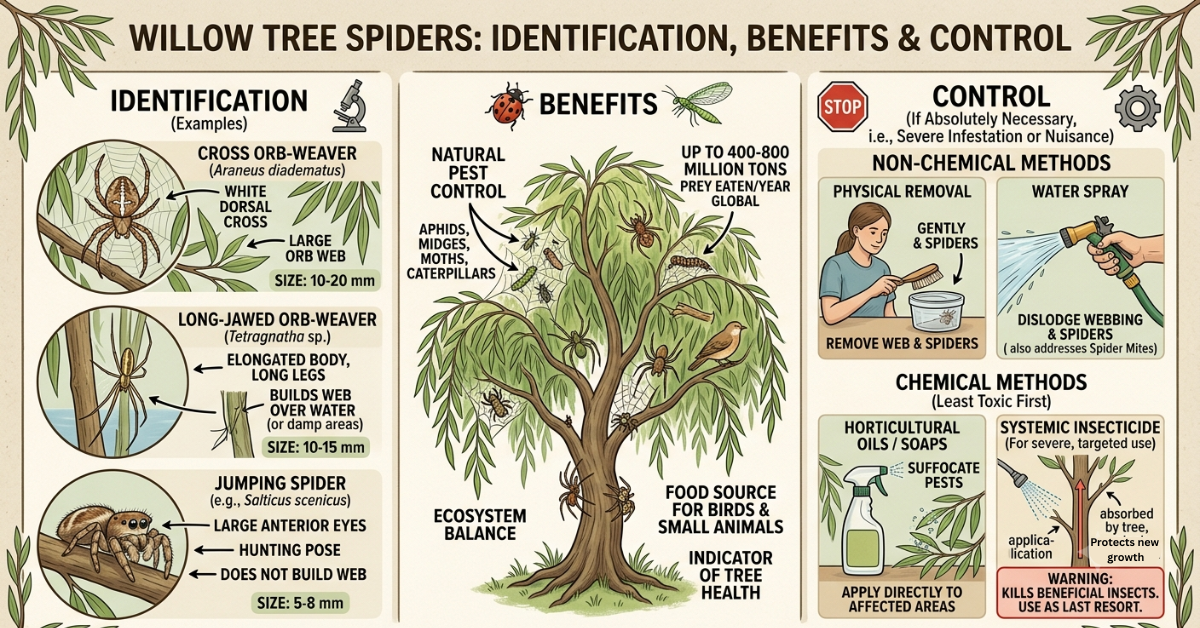

If you have ever looked at a willow and noticed a spider web tucked between the branches, you are not alone. Willow tree spiders are usually not one single species; it is a broad phrase people use for spiders that live, hunt, or build webs on willow trees. In practice, that can include orb-weavers, jumping spiders, crab spiders, and other garden spiders that use trees as hunting ground. Spiders are predators, and many are harmless to people, which makes them more useful than frightening in most landscapes.
What Are Willow Tree Spiders?
When people search for willow tree spiders, they are usually trying to identify spiders found on willow branches, bark, or leaves. Willows can attract plenty of insects, and that means more food for spiders. Aphids are especially common on willow and can distort leaves when feeding heavily, while natural enemies help keep aphid numbers down in gardens and landscapes.
Common Spiders Found on Willow Trees
Orb-weavers
Orb-weavers are the classic web builders most people picture when they think of spiders. They often spin large, wheel-shaped webs in gardens, forests, shrubs, and other plant-heavy places, which is why willow branches can be a perfect spot for them. Their webs are designed to catch flying insects, especially in late summer and autumn.
Jumping spiders
Jumping spiders do not wait in a web the way orb-weavers do. They actively hunt and can roam over plants and trees, using quick movements and sharp vision to catch prey. Some tree-dwelling jumping spiders are especially well adapted to life in the canopy, which makes willow trees a reasonable home for them.
Crab spiders
Crab spiders are ambush hunters. They often sit on leaves or flowers and wait for unsuspecting insects to come close, and some species can even blend into their background. On a willow, that means they may hide in plain sight until prey arrives.
Why Willow Trees Attract Spiders
Willows create the kind of environment spiders like: layered leaves, branching cover, and plenty of insect activity. Where there are aphids, flying insects, and other small arthropods, spiders usually follow. In residential landscapes and gardens, spiders are common predatory arthropods that help reduce pest numbers without much intervention.
Are Willow Tree Spiders Harmful?
Most spiders found on willow trees are not dangerous to humans. Extension sources describe spiders as generally docile and harmless, and they play a helpful role by feeding on insects and other small arthropods. That does not mean every spider should be handled, but it does mean a spider on a willow is usually a sign of a healthy, working ecosystem rather than a problem.
How to Identify Spiders on Willow Trees
Use these clues first:
- Web shape
Round, classic orb webs usually point to orb-weavers. - Movement style
Fast, sudden jumps often suggest a jumping spider. - Where it sits
A spider resting on a leaf and waiting for prey may be a crab spider or another ambush hunter. - Time of day
Some orb-weavers are more noticeable in the evening because they rebuild or use their webs when insect traffic is active.
Should You Remove Them?
Usually, no. If the spider is outdoors, staying on the tree, and not creating a real nuisance, it is often best to leave it alone. Spiders help manage insects naturally, and many garden spiders are part of the normal balance in a landscape. If a web is in an annoying spot, gently relocating it is better than unnecessary pesticide use.
When Spider Activity May Signal a Bigger Issue
A sudden increase in spiders can sometimes mean the tree is supporting a lot of insect prey. On willow trees, aphids are a common example, and heavy aphid feeding can damage leaves and buds. If the willow looks stressed, curled, sticky, or covered in insect clusters, the real issue may be the pest population rather than the spiders themselves.
Simple Ways to Keep Willow Trees Healthy
Healthy willows are less likely to become overwhelmed by pests. Good watering, proper pruning, and avoiding overuse of broad-spectrum insecticides can help preserve beneficial predators like spiders. Encouraging natural enemies is often a better long-term approach than trying to eliminate every spider you see.
FAQs About Willow Tree Spiders
Are willow tree spiders a real species?
Not usually. The phrase is generally used as a search term for spiders found on willow trees, not as one official species name.
What kind of spiders live on willow trees?
Common examples include orb-weavers, jumping spiders, and crab spiders. Different species use the tree in different ways, from web building to active hunting.
Are they dangerous to pets or people?
Most garden spiders are not dangerous and are considered docile and harmless to humans. Still, it is smart not to handle unknown spiders directly.
Why are there so many spiders on my willow tree?
Usually because the tree offers shelter and food. If insects such as aphids are present, spiders may gather there to hunt.
Conclusion
Willow tree spiders are usually beneficial garden spiders making use of a tree that naturally attracts insects. Orb-weavers, jumping spiders, and crab spiders may all show up on willow branches, but most are harmless and helpful. If you see them often, it is usually a sign that your willow is part of a lively little ecosystem, not that something is wrong. Explore more related garden pest and beneficial insect guides to better understand the wildlife around your trees.