
When people imagine angels, they often picture soft wings, glowing halos, and human-like faces. But the idea of biblically correct angels is far more complex—and honestly, a bit more surprising than popular culture suggests. In the Bible, angels are not always gentle-looking figures; instead, they are powerful, mysterious, and sometimes even terrifying beings described in very symbolic language.
Understanding biblically correct angels helps us see how ancient scripture presents heavenly messengers in their true form, not just modern artistic interpretations. Let’s explore what the Bible actually says about them, their roles, and why their appearance is so different from what we usually imagine.
Biblically Correct Angels in the Bible: What Are They?
The concept of biblically correct angels comes directly from scriptural descriptions rather than modern artwork or movies. In the Bible, angels are spiritual beings created by God to serve specific purposes, such as delivering messages, protecting humans, and worshipping God.
Instead of one uniform appearance, angels are described in multiple forms depending on their role. Some appear human-like, while others are described with multiple wings, eyes, or wheels covered in fire and light.
The Bible emphasizes their power and holiness more than their physical appearance, which is often symbolic rather than literal.
Types of Angels in Scripture
The Bible presents different categories of angels, each with unique roles and descriptions.
Seraphim
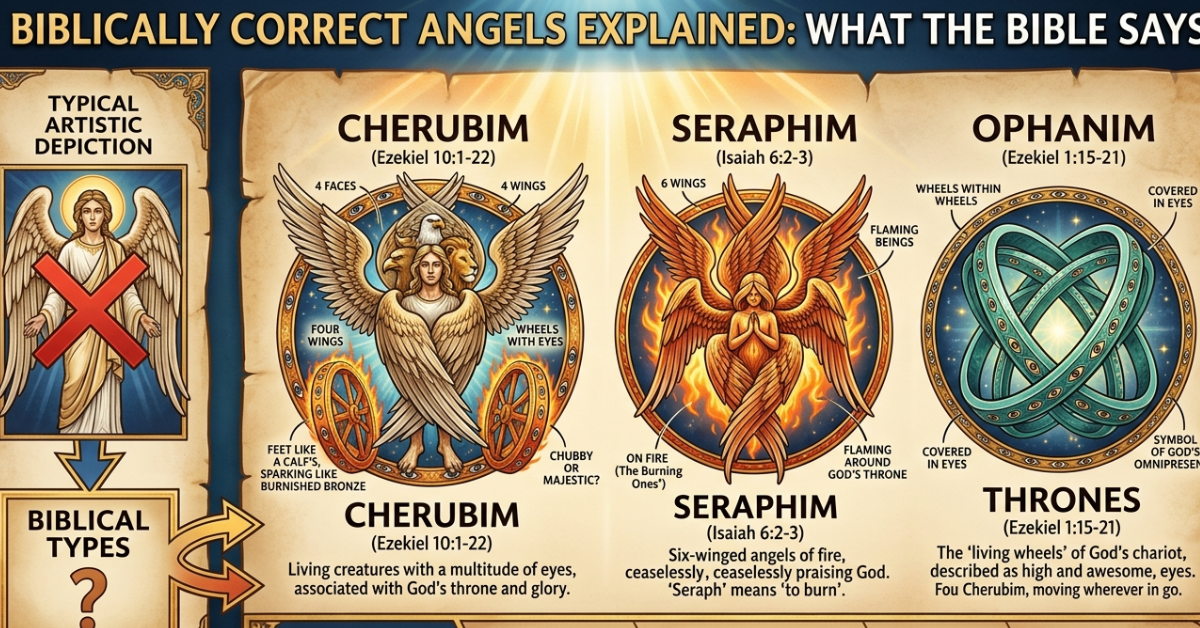
Seraphim are among the highest-ranking heavenly beings. In Isaiah’s vision, they are described as having six wings—two covering their face, two covering their feet, and two used for flying. They constantly worship God, declaring His holiness.
Cherubim
Cherubim are another fascinating type of angel. In Ezekiel’s vision, they appear with multiple faces (human, lion, ox, and eagle) and multiple wings. They are closely associated with God’s throne and divine glory.
Archangels
Archangels, such as Michael and Gabriel, are more human-like in appearance. They often act as messengers or warriors in spiritual battles, delivering important divine instructions to people.
What Do Biblically Correct Angels Look Like?
When studying biblically correct angels, one of the most surprising truths is that they do not always resemble human beings with wings.
Instead, biblical descriptions include:
- Multiple wings and eyes (symbolizing awareness and divine presence)
- Wheels within wheels surrounded by fire (Ezekiel’s vision)
- Bright, overwhelming light that causes fear in humans
- Human-like forms in certain encounters
This shows that angelic appearances are often symbolic, representing divine power, holiness, and mystery rather than a fixed physical body.
Purpose and Role of Angels
Angels in the Bible are not decorative spiritual beings. They have clear responsibilities, including:
- Delivering messages from God
- Protecting believers
- Carrying out divine judgment
- Worshipping and glorifying God continuously
- Guiding and strengthening humans during critical moments
Their actions always point back to God’s will and authority.
Common Misconceptions About Angels
Many modern ideas about angels come from art, movies, and cultural traditions rather than scripture. Because of this, the idea of biblically correct angels often surprises people.
Some common misconceptions include:
- Angels always look like humans with wings
- Angels are soft, harmless beings
- All angels have halos
- Angels exist mainly to comfort humans
In reality, the Bible portrays them as powerful spiritual beings who often inspire awe and fear.
Symbolism Behind Angelic Descriptions
Biblical descriptions of angels are often symbolic rather than literal. The strange imagery—like multiple eyes or wheels of fire—represents deeper meanings:
- Eyes symbolize knowledge and awareness
- Wings symbolize speed and divine service
- Fire represents purity and God’s presence
- Multiple faces symbolize intelligence and completeness
Understanding this helps us interpret biblically correct angels in a more meaningful way.
FAQs About Biblically Correct Angels
1. Are angels humans with wings?
No, the Bible does not describe angels as humans with wings in most cases. Only certain angelic beings are described with wings.
2. Why do angels look so strange in the Bible?
Their descriptions are symbolic, representing divine qualities rather than physical appearance.
3. Do angels have gender?
The Bible does not assign gender to angels; they are spiritual beings.
4. What is the strongest type of angel?
Archangels like Michael are often shown as warrior angels, but all angels serve God’s authority.
5. Why is understanding biblically correct angels important?
It helps readers interpret scripture more accurately and avoid cultural misconceptions.
Conclusion
The study of biblically correct angels reveals a fascinating truth: angels are not simple, decorative figures but powerful spiritual beings with diverse forms and deep symbolic meaning. From fiery wheels to six-winged seraphim, the Bible presents a much richer and more mysterious picture than modern imagination suggests.
By understanding their true nature, we gain a deeper appreciation of their role in divine order and their connection to God’s plan. If anything, angels remind us that the spiritual world is far more complex—and far more awe-inspiring—than we often realize.