
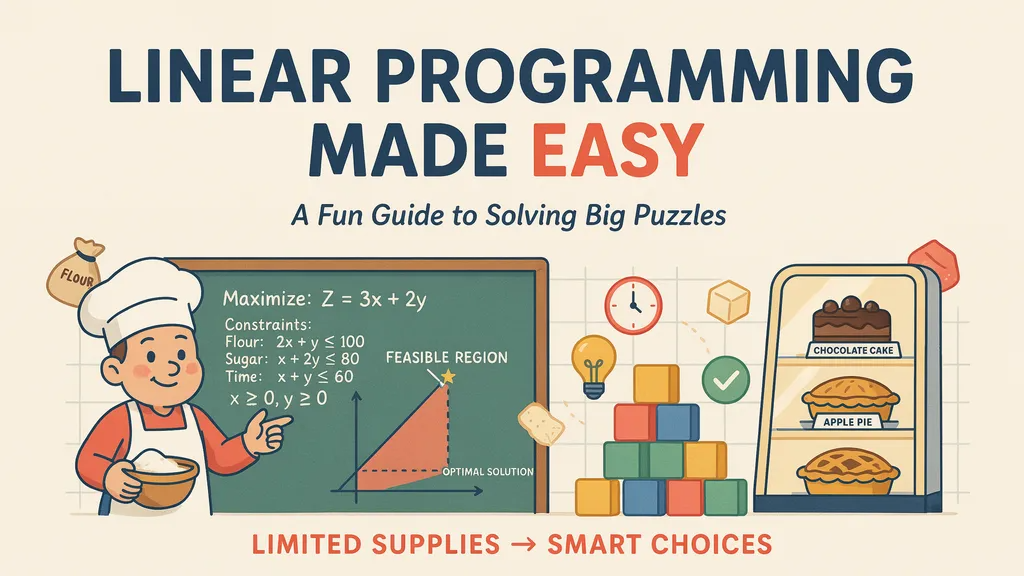

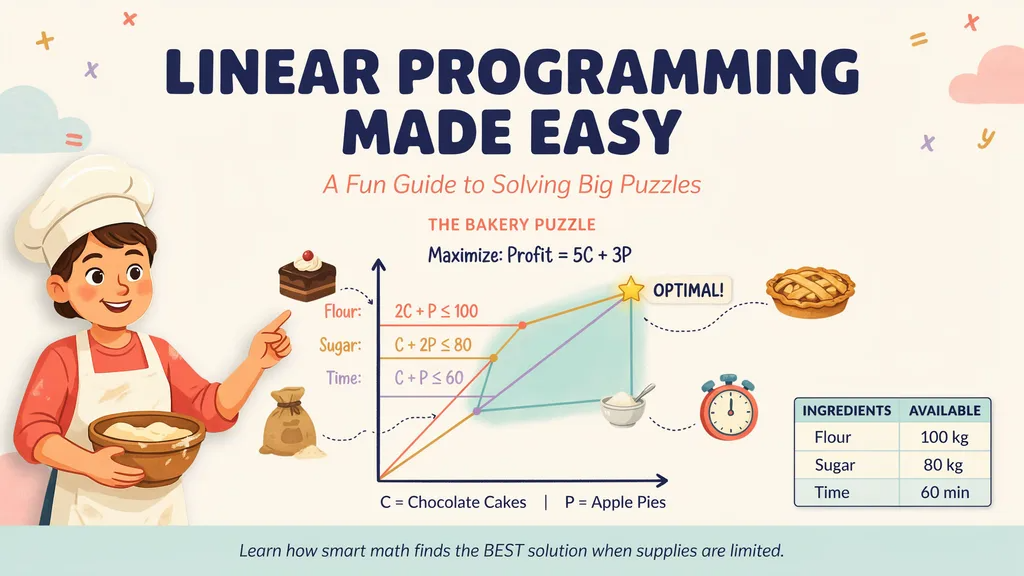
Imagine you have a big box of colorful building blocks and want to build the coolest tower possible without running out of pieces. That is very similar to what Linear Programming does for big companies and smart scientists every single day. At its heart, linear programming is a special math trick. It helps us find the absolute best way to do something when we have limited supplies. For example, a local bakery might want to figure out how many chocolate cakes and apple pies to bake each morning. They only have so much flour, sugar, and time in the kitchen. Linear programming steps in like a helpful friend to solve this puzzle. It looks at all our rules and limits, which experts call constraints, and points us straight to the smartest choice. By using linear programming, businesses stop guessing and start making choices based on clear, helpful numbers. It takes messy, confusing problems and turns them into neat little paths we can easily follow.
The Magic Ingredients of a Math Puzzle
Every time we use linear programming, we are really working with a few simple puzzle pieces. The most important piece is our main goal, which mathematicians call the objective function. This just means we want to either make our profit as big as possible or keep our costs as small as possible. Think of it like trying to get the highest score in a video game while using the fewest health potions. Alongside our main goal, linear programming always looks closely at our real-world limits. If you only have ten dollars to spend at the candy store, that money limit is one of your strict constraints. When we set up a linear programming model, we put all these pieces together in a neat math sentence. This careful setup ensures that our final answer is not just a wild guess, but a rock-solid solution that respects every single rule we have set up for ourselves.
Solving Real-World Puzzles Every Day
You might wonder where adults actually use linear programming outside of a boring school textbook. The truth is, linear programming hides behind almost everything we enjoy in our modern daily lives. When a giant delivery truck drops off your new toy or favorite book, a computer used linear programming to find the fastest and cheapest driving route. This saves fuel, keeps pollution low, and makes sure packages arrive right on time. Airplane companies also rely heavily on linear programming to schedule their flight crews across the globe without making pilots work too many tired hours in a row. Even local farmers use linear programming to decide which seeds to plant in their fields to grow the most food possible. Whenever humans need to squeeze the absolute most value out of limited time, money, or materials, linear programming quietly saves the day.
Turning Word Problems Into Math Pictures
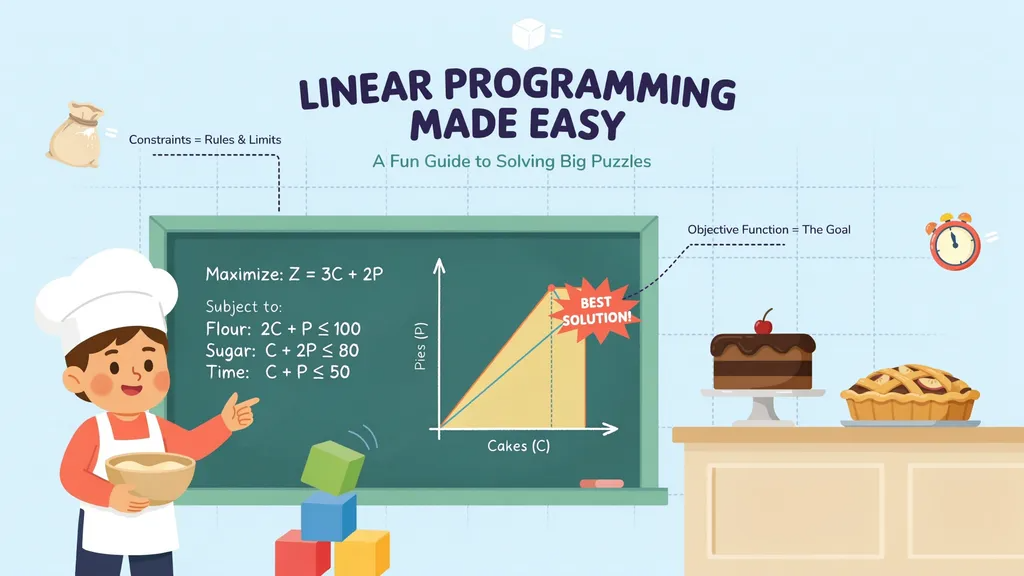
Sometimes, looking at a big wall of text can make our brains feel super tired. That is why turning a word puzzle into a visual picture is such a powerful part of linear programming. When we graph our equations on a big piece of grid paper, our linear programming problem suddenly turns into a colorful shape. The edges and corners of this shape hold all the secret answers we have been searching for. Experts call this special boundary the feasible region, which is just a fancy way of saying “the zone where all our rules are happy.” By testing just a few corners inside this shaded zone, our linear programming solver finds the champion spot instantly. It feels a bit like playing a game of treasure map coordinates where the gold chest always sits right on a corner vertex. Drawing things out makes hard math feel much more like a fun art project.
Handy Tools We Use for Big Calculations
Back in the old days, solving a massive linear programming puzzle meant spending hours sharpening pencils and doing long division on scratch paper. Today, we are super lucky because fast computers and clever software handle all the heavy lifting for us. Programs built with linear programming algorithms can crunch millions of numbers in less than a blink of an eye. Whether a company uses a simple spreadsheet or fancy coding software, these digital tools make linear programming accessible to anyone. You simply type in your main goals and your strict limits, and the computer hands you the winning answer on a silver platter. This incredible speed means managers can test different ideas safely on a screen before spending any real money in the physical world. Technology truly turns linear programming into a superpower for everyday problem solvers.
Why Rules and Limits Matter So Much
Some kids might think rules are just boring roadblocks that stop us from having fun. But in the world of linear programming, rules are actually the secret ingredients that make the whole system work. Without clear limits, an optimization model would just tell a company to make an infinite number of products or spend an infinite amount of money. Because resources like time, electricity, and raw steel are always limited, linear programming keeps our feet firmly planted on the ground. These boundaries force us to be creative and smart with what we already have around us. When we embrace our limits inside a linear programming framework, we discover clever shortcuts we never would have noticed otherwise. Rules give the math puzzle a neat shape, turning chaos into total clarity.
The Big Comparison Table
To help you see how different parts of a math puzzle fit together, let us look at a quick comparison chart. This table breaks down the main ideas behind linear programming using simple, everyday language that anyone can easily understand.
| Puzzle Part | Simple Definition | Real-World Example |
| Objective Function | The main goal you want to reach. | Making as much money as possible at a lemonade stand. |
| Decision Variables | The choices you get to make. | How many cups of lemon juice and sugar to buy. |
| Constraints | The strict rules or limits you must follow. | Having only five dollars and one hour of free time. |
| Feasible Region | The safe zone where all rules are happy. | All the possible combinations you can actually afford. |
| Optimal Solution | The single best winning choice on the map. | The exact recipe that gives you the highest profit. |
Step-by-Step Guide to Setting Up a Model
Getting started with your very first math model does not have to feel scary or confusing at all. If you want to use linear programming like a certified pro, you just need to follow three friendly little steps. First, figure out what you are trying to change and write down your choices clearly. Second, write down all your annoying rules and limits so you do not accidentally break them later. Third, write your main goal as a simple equation that connects your choices to your ultimate prize. Once these three pieces of your linear programming puzzle sit neatly on your desk, you are completely ready to solve the whole thing. Writing everything down in order keeps your thoughts organized and stops your brain from getting tangled up in messy numbers.
Common Mistakes Beginners Often Make
Even smart people can sometimes trip up when they first start exploring this topic. One classic mistake in linear programming is forgetting to include a hidden rule, like making sure your final answer cannot be a negative number. After all, a factory cannot build negative three cars in real life! Another frequent error in linear programming is writing an objective goal that does not actually match what the business owner wants to achieve. If a store owner wants more happy customers, but their math model only looks at saving paper clips, their linear programming results will lead them down the wrong path. Paying close attention to the small details helps us avoid these silly traps and keeps our math journey smooth, happy, and successful.
Why Optimization Changes How We Think
Learning how to structure puzzles changes the way your brain looks at everyday choices. When you understand the basics of linear programming, you start seeing hidden puzzles everywhere you look in the real world. You might start organizing your school backpack to fit the maximum number of books without breaking the zipper, or planning your Saturday chores to finish as fast as possible. This analytical mindset is the ultimate gift that linear programming gives to curious learners of all ages. It teaches us that every big, messy problem can be broken down into bite-sized pieces and solved with a little bit of logical thinking. By practicing these foundational skills early on, you build a strong mental toolbox that will help you tackle bigger challenges as you grow up.
Conclusion
We have taken a fun journey through the wonderful world of linear programming today. From understanding simple constraints to reading helpful comparison charts, you now know how big puzzles get solved. Linear programming takes messy real-world limits and turns them into clear, winning pathways for everyone. Why not try making your own little puzzle today by planning your daily snack schedule using these exact same smart steps? Share your favorite optimization ideas in the comments below or pass this guide along to a friend who loves solving cool math challenges!
Frequently Asked Questions
What does linear programming actually mean in simple words?
It is a clever math method that helps us find the absolute best way to solve a puzzle when we have strict limits on our time or supplies.
Why do we call it “linear”?
We call it linear because all the math rules and equations form straight lines when you draw them out on a graph.
Can kids use linear programming for everyday tasks?
Yes, absolutely! You can use these same ideas to organize your school schedule, plan a birthday party budget, or pack your travel suitcase efficiently.
What is a constraint in a math puzzle?
A constraint is just a strict rule or limit that you must follow, such as having a specific budget or a limited amount of time.
Do I need a fancy computer to solve these puzzles?
Not for small puzzles! You can easily solve simple problems using a piece of grid paper, a pencil, and your own brain power.
Where can I learn more about advanced math models?
You can check out fun online math games, read library books about puzzles, or explore free educational websites dedicated to science and logic.